Ashth - Where Exceptional Craftsmanship Defines Modern Luxury !

- Rings
- Earrings
Shop By Category
- Bangles/ Bracelets
Shop By Category
- Necklaces
Shop By Category
- Pendants
Shop By Category
- ASHTH LITE
Shop By Category
.jpg)
- Collections
Collections

Shop By Category
Shop By Category
Shop By Category
Shop By Category
Shop By Category
Collections
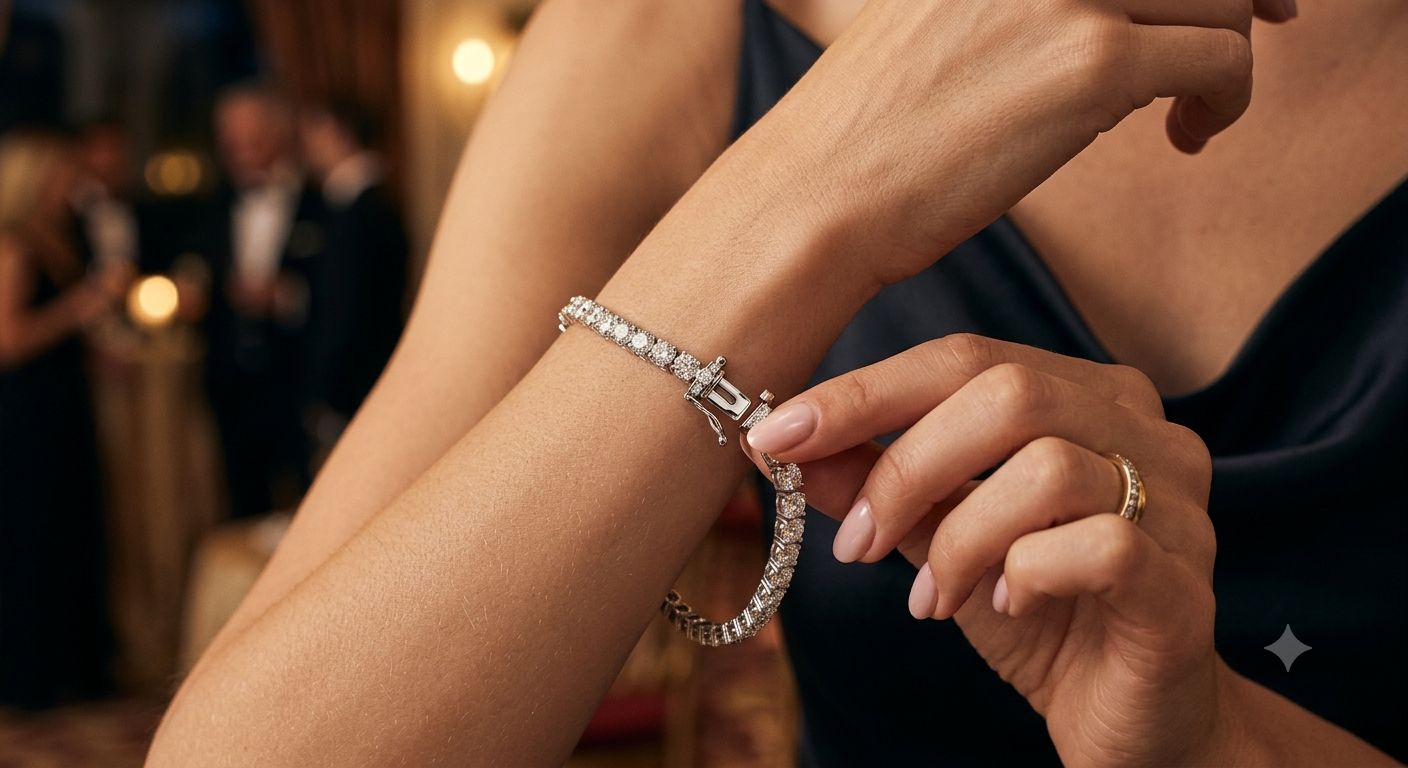
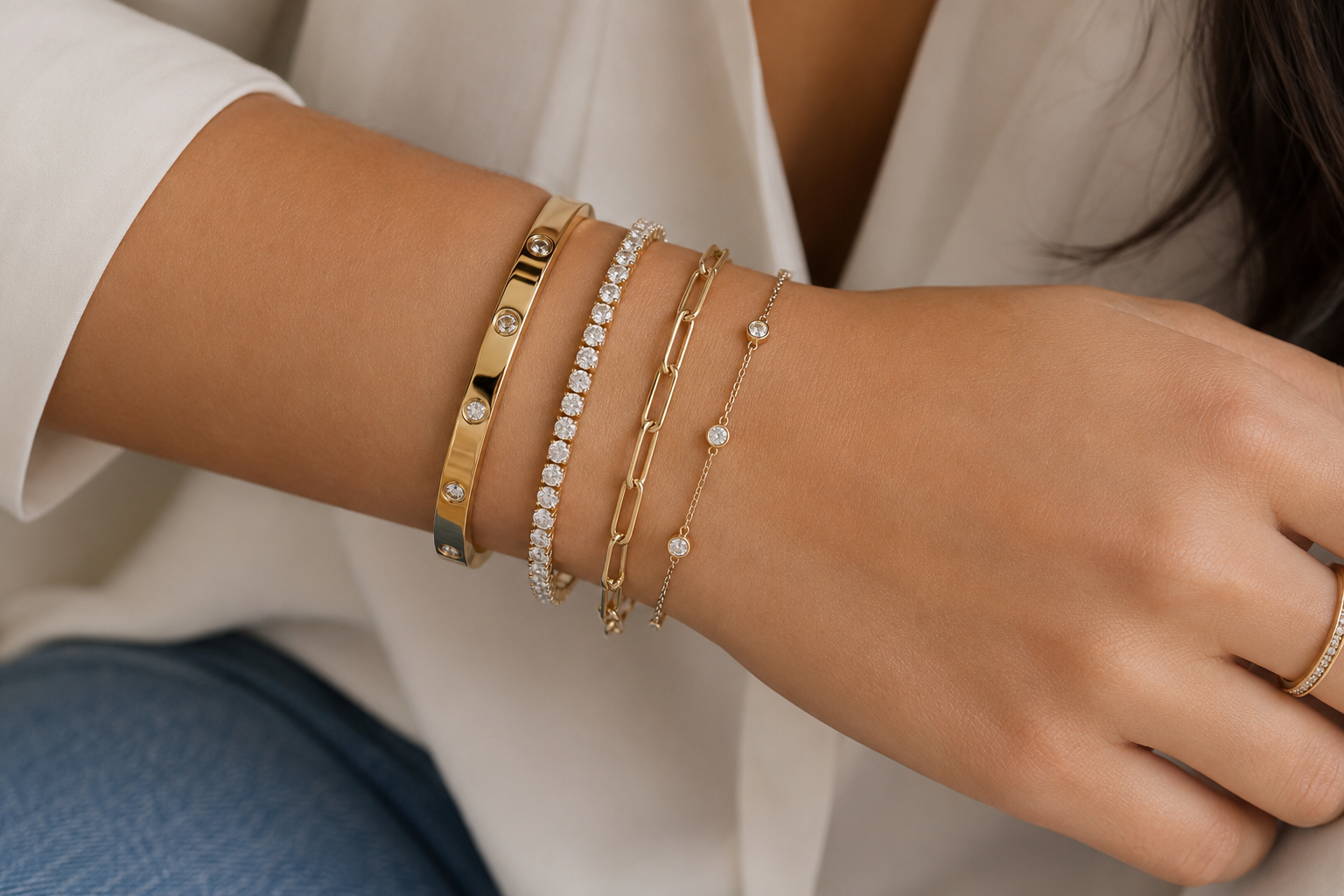
Most people shopping for a tennis bracelet spend their time comparing carat weight, clarity, and setting style. Understandably so — those are the details you can see. But after twenty years of working with clients on their fine jewelry, I can tell you the part that actually determines whether you keep that bracelet is the one nobody asks about: the clasp.
A safe tennis bracelet clasp uses two independent locking points — typically a box clasp with a reinforced safety wing — so that if the primary lock loosens, a secondary mechanism still holds the bracelet in place. Single-lock clasps, like a standard lobster claw, have no backup. Once that spring fatigues, there's nothing standing between your diamonds and the sidewalk.
I've seen the aftermath of clasp failure more times than I'd like. A client walks in holding a broken bracelet chain, hoping I can somehow reconstruct what's missing. Sometimes I can. Often, the stones scattered somewhere between the restaurant and the parking garage are simply gone.
Rings sit still. Necklaces mostly hang. Bracelets move constantly — every handshake, every gesture, every time you reach for your keys puts tension directly on that small locking mechanism at your wrist. It's doing more work than any other part of the piece, and it's usually the cheapest component to manufacture.
That mismatch is the root of the problem. A jeweler can source flawless lab-grown or natural diamonds and mount them in beautifully worked platinum, and still undermine the whole piece with a clasp that was never built to handle daily wear.
The financial loss stings, but it's rarely the worst part. I've had clients tell me the bracelet was from a mother who'd passed, or a gift from a milestone anniversary. Insurance can replace the appraisal value. It cannot replace what the piece actually meant.
Lobster claw clasps are everywhere because they're cheap to produce and easy to use one-handed. The spring inside is small, though, and small springs fatigue fast. After a year or two of daily wear, that same satisfying click gets softer. Softer click means weaker closure means higher risk. Add hand lotion or sunscreen residue into the mechanism, and you've got a clasp that looks fine but closes incompletely.
Fold-over clasps hide well against the bracelet line, which is why designers love them for sleeker pieces. The tradeoff is the hinge. Repetitive wrist motion — typing, driving, cooking — gradually loosens that hinge until the fold-over can lift on its own. I tell clients: if your bracelet has this style, get in the habit of glancing down at your wrist a few times a day. It sounds excessive. It isn't.
Box clasps with a safety wing are, without much debate among people who repair jewelry for a living, the gold standard. You get two separate systems: the box lock itself, and a secondary latch that catches the bracelet even if the box lock disengages. If you're pairing a serious diamond purchase with other fine pieces — say, lab diamond rings for an anniversary set — this is the clasp style worth insisting on for anything you'll wear regularly.
Every open-and-close cycle puts microscopic stress on the metal. It's not dramatic on any single day. It adds up.
Gold springs lose their elasticity noticeably faster than platinum ones — gold is simply a softer alloy, and softness under repeated tension means fatigue. If you wear a bracelet daily and you're choosing between metals for the clasp mechanism specifically, platinum earns its price premium here.
Weight matters more than most buyers realize, too. A bracelet with a higher total carat weight is heavier, and that extra weight puts continuous pull on the lock all day. The jump ring — that small connector between the clasp and the bracelet chain — takes more of that load than people expect. A bent or worn jump ring can compromise an otherwise perfect clasp, which is why goldsmiths check it separately during inspections rather than assuming it's fine just because the clasp looks intact.
Then there's exposure. Lotion, sunscreen, chlorine, saltwater — none of it is doing your clasp any favors. These aren't dramatic, one-time events; they're slow corrosion and buildup that stiffen springs and gum up hinges over months of ordinary wear. Temperature swings add their own quiet toll, expanding and contracting the metal just enough, over and over, to accelerate fatigue nobody notices until it's already a problem.
A client once brought in a bracelet that had been in her family for three generations. The safety wing had snapped off years earlier — a small, cheap repair that kept getting postponed. She wore it to a dinner. At some point during the evening, the primary clasp opened on its own, and the bracelet slipped away unnoticed.
We never found it. The repair, had it been done, would have cost a few hundred dollars. What was lost cannot be priced.
This isn't a rare story in this business. Clasp failure is consistently cited by jewelry professionals as one of the leading causes of bracelet loss, and single-lock mechanisms fail at meaningfully higher rates than dual-lock systems, for the obvious reason that there's no backup when the first lock lets go.
You don't need special tools for a basic monthly check. Open and close the clasp a few times. It should snap firmly, with real resistance — not a soft, uncertain click. Gently pull both ends apart while it's closed. If the safety latch doesn't engage decisively, or the clasp opens with less effort than it used to, that's your early warning.
Look closely, too, for hairline cracks near the hinge, a bent locking pin, any visible gap between clasp components, or a safety wing that sits slightly loose. These small defects rarely stay small. Under daily wear, they get worse quickly.
Quick monthly self-check:
Open and close the clasp several times — listen and feel for a firm snap
Gently test tension with both hands
Confirm the safety wing locks with resistance, not just contact
Scan for hairline cracks, bent pins, or gaps under good light
I generally recommend a professional inspection every six to twelve months, with prong tightening handled annually at the same visit. Most repair shops charge relatively little for this compared to the cost of losing the piece — often somewhere in the range of a routine cleaning fee, well under what most people assume.
If you're on your feet, working with your hands, or simply someone who gestures a lot when you talk, prioritize security over how discreet the clasp looks. A reinforced double-lock box clasp, a sturdy jump ring, and a hinge built from quality metal will outlast a more delicate-looking alternative by years.
Before any formal event — the kind where you're getting dressed quickly and juggling multiple accessories — take thirty seconds to check both locks, confirm the safety wing is engaged, and make sure the bracelet isn't sitting so loose that it can slide over your hand. It's a small habit that prevents a genuinely bad night.
For bracelets you plan to wear often or pass down, it's worth asking your jeweler about upgrading the factory clasp entirely. Custom reinforced box clasps, platinum locking mechanisms, and heavier jump rings are all reasonable investments relative to the value they protect. Some collectors go a step further and add a discreet safety chain, which keeps the bracelet tethered even in the rare case the primary clasp fails completely. If you're building out a broader collection — princess cut diamond rings alongside a tennis bracelet, for instance — this kind of upgrade is worth budgeting for across every piece you wear regularly, not just the bracelet.
A tennis bracelet's diamonds get all the attention at the counter. The clasp is what determines whether those diamonds are still on your wrist by the end of the day. Between the two, I'd rather sell a client a slightly smaller stone with a genuinely secure double-lock clasp than a showstopper bracelet with a mechanism that isn't built for daily life.
Before you buy — or before you keep wearing what you already have — confirm it has:
A double-locking box clasp
A functioning safety wing or latch
A solid, undamaged jump ring
Quality metal construction suited to how often you'll wear it
A firm, confident locking action
A standing inspection schedule with your jeweler
How do I know if my tennis bracelet clasp is wearing out?
Watch for a softer click when closing it, a safety wing that doesn't engage firmly, or visible gaps at the hinge. Any of these means it's time for an inspection, not a "wait and see."
How much does it cost to repair a tennis bracelet clasp?
Most basic clasp repairs — tightening a spring, replacing a safety wing — cost a fraction of what a full bracelet replacement would run. It's one of the least expensive preventative repairs in fine jewelry.
How often should a tennis bracelet be professionally checked?
Every six to twelve months for active wear, ideally paired with your annual prong-tightening appointment so you're not making separate trips.
Is a box clasp really safer than a lobster clasp?
Yes, structurally. A lobster clasp has one point of failure. A box clasp with a safety wing has two, which means the bracelet can survive a single mechanical failure without coming loose.

 Round
Round Pear
Pear Heart
Heart PRINCESS
 Oval
Oval CUSHION
 EMERALD
 MARQUISE
 Asscher
 RADIANT
 Ashth CUT
 ROSE CUT
 BRIOLETTE
 SINGLE CUT
 TRAPEZIUM
 TULIP
TULIP TRIANGLE
 BUTTERFLY
 FLOWER
 MOVAL
MOVAL CLOVER
 BAGUETTE
 9KT ASHTH CUT
 9KT MARQUISE
 9KT PEAR
 9KT RADIANT
 9KT EMERALD